An inflatable kayak offers unparalleled freedom, allowing paddlers to explore serene lakes and winding rivers with ease. However, few things disrupt a peaceful day on the water faster than realizing your trusty inflatable kayak is losing air. The good news is that most leaks are preventable or easily fixable with the right approach and a few simple tools. Understanding why your inflatable kayak might be leaking air and knowing how to swiftly address these issues will keep you paddling confidently.
Understanding Why Your Inflatable Kayak Leaks Air
Inflatable kayaks are durable, but like any gear, they can encounter issues over time. Air loss isn’t always a catastrophic puncture; often, it’s a minor problem that’s simple to diagnose and repair. Identifying the root cause is the first step toward getting back on the water quickly.
Common Culprits: Valves, Punctures, and Seams
|
Our Picks for the Best Inflatable Kayak in 2026
As an Amazon Associate I earn from qualifying purchases.
|
||
| Num | Product | Action |
|---|---|---|
| 1 | GYMAX Inflatable Kayak, 12.5Ft 507lbs Tandem Kayak with 2 Aluminum Paddles, 2 Padded Seats, Footrests, 2 Fins, Hand Pump, Carry Bag & Repair Kit, 2 Person Fishing Touring Kayak for Adults |

|
| 2 | INTEX Challenger Inflatable Kayak Series: Includes Deluxe 86in Kayak Paddles and High-Output Pump – SuperStrong PVC – Adjustable Seat with Backrest – Removable Skeg – Cargo Storage Net |
|
| 3 | Intex 68307EP Explorer K2 Inflatable Kayak Set: Includes Deluxe 86in Aluminum Oars and High-Output Pump – SuperStrong PVC – Adjustable Seats with Backrest – 2-Person – 400lb Weight Capacity |
|
| 4 | INTEX 68324EP Excursion 4 Inflatable Boat Set: Includes Deluxe 54in Boat Oars and High-Output Pump – Adjustable Seats with Backrest – Fishing Rod Holders – 4-Person – 1100lb Weight Capacity |
|
| 5 | Intex 68309EP Excursion Pro K2 Inflatable Kayak Set: Includes Deluxe 86in Kayak Paddles and High-Output Pump – SuperTough PVC – Adjustable Bucket Seat – 2-Person – 400lb Weight Capacity |
|
| 6 | Intex Challenger K1 Kayak Kit |
|
| 7 | INTEX 68303EP Excursion Pro K1 Inflatable Kayak Set: Includes Deluxe 86in Kayak Paddles and High-Output Pump – SuperTough PVC – Adjustable Bucket Seat – 1-Person – 220lb Weight Capacity |
|
| 8 | Advanced Elements - AdvancedFrame Sport Inflatable Kayak - Lightweight Day Touring Kayak with Bag and Pump |
|
| 9 | Retrospec June Nano Kids Inflatable Fishing Paddle Board SUP Kayak: 9'6" Hybrid Paddleboard with Rod Holders, Removable Seat - Lightweight Portable Youth Fishing Board |
|
| 10 | INTEX Challenger Inflatable Kayak Series: Includes Deluxe 86in Kayak Paddles and High-Output Pump – SuperStrong PVC – Adjustable Seat with Backrest – Removable Skeg – Cargo Storage Net |
|
The most frequent cause of slow air loss in an inflatable kayak comes from its valves. Over time, valves can become loose, collect dirt, sand, or grit, or even have worn-out O-rings. These small imperfections break the seal, allowing air to slowly escape. Beyond the valves, punctures are another common issue. Sharp objects like rocks, submerged branches, or even fishing hooks can create pinholes or small cuts in the kayak’s material. While less common in newer, quality kayaks, leaks can also originate from the seams, which might delaminate or weaken over many years of use.
Environmental Factors and Wear
Beyond direct damage, several environmental factors contribute to air loss. Temperature fluctuations are a significant, often misunderstood, cause. Air expands when warm and contracts when cold; if your kayak feels softer after sitting in cooler water or shade, it might just be the air inside contracting, not a leak. Over-inflation, especially in direct sunlight, can also stress the material and seams, leading to tiny leaks or material fatigue. Improper handling, such as dragging the kayak over rough surfaces, and general wear and tear from sun exposure, salt, and debris, can slowly degrade the material, making it more susceptible to leaks.
The Art of Leak Detection: Finding the Source of Air Loss
Locating a leak, especially a slow one, requires patience and a systematic approach. Don’t immediately assume the worst; start with the most common problem areas.
Visual and Auditory Clues
Begin by fully inflating your kayak until it’s firm. First, perform a thorough visual inspection. Look for any obvious signs of damage: cuts, scrapes, abrasions, or holes. Pay close attention to high-wear areas and the underside of the kayak. Next, listen carefully. In a quiet environment, you might hear a faint hissing or whistling sound. Sometimes, a child’s ears, with their superior high-frequency hearing, can pinpoint an elusive leak faster than an adult’s.
 A person listening closely to an inflated inflatable kayak for hissing sounds, with a calm lake in the background and soft sunlight, realistic style
The Soapy Water Method: Your Best Bet
The most reliable and universally recommended method for finding leaks is the soapy water test.
- Prepare the Solution: Mix a generous amount of liquid dish soap, shampoo, or general-purpose detergent with water in a spray bottle. A 50/50 mix is often recommended, but a higher soap concentration can be even more effective for tiny leaks.
- Inflate Fully: Ensure your kayak is inflated to its maximum recommended pressure.
- Start with Valves: Spray the soapy solution generously around and into each inflation valve. Watch closely for bubbles forming and growing; this is a tell-tale sign of escaping air. Check the valve fitting, base, and the internal pushpin.
- Check Seams: Systematically spray the soapy mix along all seams of the kayak. Seams are critical areas where two pieces of material are joined, making them potential leak points.
- Cover the Surface: If the valves and seams appear airtight, proceed to spray the entire surface of each air chamber, working in small sections (e.g., one square foot at a time). Spread the solution with a cloth or sponge, watching intently for any growing bubbles. A bubble over a leak will continue to expand as air escapes, unlike surface foam which might just dissipate.
- Mark the Spot: Once you find a leak, immediately mark it clearly with a waterproof marker or a piece of masking tape.
Advanced Techniques for Stubborn Leaks
For extremely slow or hidden leaks, you might need to get creative. If your kayak has removable internal bladders, deflate the leaky section, remove the bladder, inflate it, and then submerge it in a bathtub or large container of water, carefully watching for a stream of tiny bubbles. For non-bladder kayaks, once you’ve narrowed down the general area with the soapy water test, applying more pressure to that section of the kayak can sometimes make very small leaks more apparent. Some professionals even suggest a glycerin-water solution, as glycerin creates higher-tensile strength bubbles that are more persistent and easier to spot for ultra-slow leaks.
Quick Fixes: Repairing Your Inflatable Kayak
Once you’ve located the leak, the repair process can often be completed quickly, getting you back on the water with minimal downtime. The method depends on the type and size of the leak.
Addressing Valve Leaks
Valves are often the easiest to fix.
- Tighten the Valve: The most common solution for a leaky valve is simply tightening it. Use a valve wrench (often included with your kayak or pump) to give the outer section of the valve a quarter to half turn clockwise until it’s snug. Don’t overtighten, but ensure it’s firm.
- Clean the Valve: If tightening doesn’t work, the leak might be due to sand, dirt, or debris trapped within the valve mechanism or around its seals.
- External Cleaning: If the leak is around the perimeter of the valve, carefully remove the top part, clean the sealing surfaces on both the valve and the kayak material with alcohol or a damp cloth, and check the O-rings for damage. Reassemble and tighten. Ensure the bottom piece doesn’t fall into the chamber if you fully separate the valve.
- Internal Cleaning: If the leak is from within the valve’s throat, grit might be preventing the inner flap from sealing. You can try a quick release of air to blow out debris, or use a cotton swab moistened with 303 Protectant or soapy water to clean the inner flap.
- Valve Replacement: If these steps don’t resolve the issue, the valve itself might be damaged or have a worn-out rubber seal. Replacing the valve might be necessary, and for some complex valves, this is best left to a professional to ensure proper sealing and avoid damaging the kayak material.
Patching Small Punctures and Pinholes
For tiny punctures (less than 1/8 inch or pinhole size), a patch isn’t always necessary for a quick, temporary fix.
- Clean and Dry: Deflate the affected chamber. Thoroughly clean the area around the pinhole, removing any dirt, salt, or oils. Dry it completely.
- Apply Glue/Sealant: Apply a small drop of specialized PVC or vinyl repair glue (often included in kayak repair kits) directly over the pinhole. Ensure it covers the entire puncture.
- Cure Time: For a permanent repair, allow the glue to cure for at least 12 hours. If you need to get back on the water sooner, some glues allow for partial inflation (¾ full) after about 30 minutes, but this might not be a permanent solution.
Mastering the Patch Kit: For Larger Repairs
For cuts or holes larger than a pinhole, a dedicated patch kit is essential. Ensure your kit’s patch material and adhesive are compatible with your kayak’s fabric (PVC, Hypalon, or TPU).
Preparing the Area and Patch
- Deflate Fully: Completely deflate the chamber with the leak.
- Clean Thoroughly: Clean the area around the marked leak (at least 2 inches larger than the damage) and the backside of the patch. Use a solvent like MEK, denatured alcohol, or toluene. Crucially, avoid silicone-based cleaners like Armorall, as they prevent proper adhesion. Ensure both surfaces are bone dry.
- Cut the Patch: Cut a rounded patch that is at least 1 to 2 inches larger than the hole in all directions. Rounded corners prevent peeling.
- Outline and Mask: Place the patch over the hole and trace its perimeter with a pencil. Then, apply masking tape around the outside of the pencil line on the kayak. This creates a neat border and prevents excess glue from spreading.
- Lightly Abrade (if Hypalon): If your kayak is made of Hypalon, lightly sand the kayak surface within the traced area and the backside of the patch to create a “key” for the adhesive. This step is generally not required for PVC kayaks.
Applying Adhesive and Curing
- Apply Adhesive: Using a small brush, apply a thin, even coat of the specialized adhesive to both the cleaned kayak surface (within the masked area) and the back of the patch. Don’t apply too much; contact cements work best when thin.
- Allow to Dry/Tack: Let the first coat of glue dry for 5-8 minutes, or until it’s dry to the touch but slightly tacky (check with a knuckle, as fingertips have oils). Some kits may recommend a second thin coat after this initial drying period.
- Position the Patch: Carefully place the patch over the hole, aligning it within your pencil marks. Contact adhesives bond immediately, so precise placement is key.
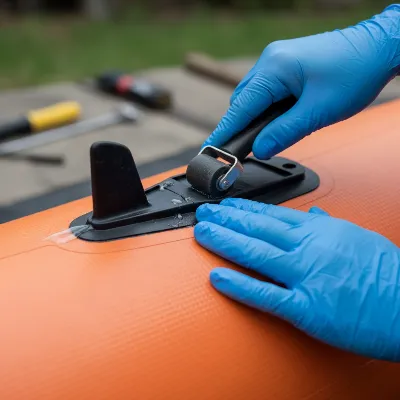
- Apply Pressure: Press the patch down firmly, working from the center outwards. Use a roller, the handle of a screwdriver, or a dull putty knife to smooth out any air bubbles and ensure complete adhesion. For best results, place a flat, heavy object (like a book or piece of wood) over the patch and clamp it or weigh it down for several hours.
- Cure Completely: Allow the patch to cure for at least 12-24 hours before re-inflating the kayak to full pressure. This ensures a strong, durable bond.
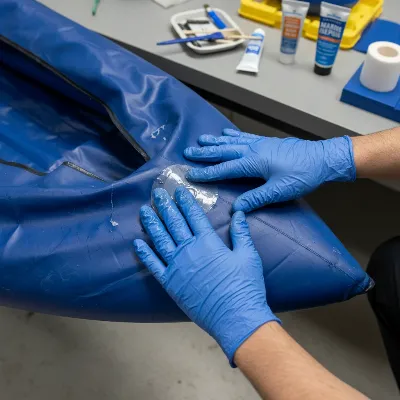 Hands applying a patch to an inflatable kayak with glue, showing careful alignment and smoothing, realistic style
Proactive Care: Preventing Future Inflatable Kayak Leaks
Prevention is always better than repair. Adopting good habits can significantly extend the life of your inflatable kayak and keep it leak-free.
Proper Inflation and Handling
Always inflate your kayak to the manufacturer’s recommended PSI (pounds per square inch). Over-inflating, especially on a hot day, puts undue stress on seams and material, making leaks more likely. If your kayak will be sitting in direct sunlight for extended periods, consider releasing a small amount of air to accommodate expansion. When launching or landing, always choose smooth surfaces and avoid dragging your kayak over sharp rocks, asphalt, or abrasive debris. Be mindful of underwater hazards that could puncture the hull.
Regular Cleaning and Inspection
Make it a routine to rinse your inflatable kayak with fresh water after every use, especially after paddling in saltwater. This removes salt, sand, and other debris that can slowly wear down the material and get into valves. After rinsing, dry your kayak completely before storage to prevent mold, mildew, and fabric breakdown. Regularly inspect your kayak for small cuts, abrasions, or loose valves. Catching minor issues early can prevent them from escalating into major leaks.
Smart Storage Solutions
Storing your inflatable kayak properly is crucial for its longevity. Keep it in a cool, dry, shaded area, away from direct sunlight, extreme temperatures, and curious critters. If storing for a long period, it’s best to fully deflate and clean it, then fold it loosely into its carry bag. Avoid tightly folding it in the same creases repeatedly, as this can weaken the material. Store it off the ground to prevent moisture buildup from the floor.
“Preventing leaks often comes down to simple common sense and consistent care. A little vigilance goes a long way in ensuring your inflatable kayak is ready for every adventure.” – Admin, ReviewsPronto.com
Conclusion
A leaking inflatable kayak doesn’t have to signal the end of your paddling adventures. By understanding the common reasons for air loss – from tricky valves and minor punctures to general wear and environmental factors – you gain the power to troubleshoot effectively. Armed with a simple soapy water solution for detection and a basic repair kit, you can swiftly fix most issues, whether it’s tightening a valve or patching a small hole. More importantly, consistent care, proper inflation, cautious handling, and smart storage are your best defenses against future leaks. Embrace these practices, and your inflatable kayak will remain a reliable companion for countless memorable journeys. What’s your top tip for keeping an inflatable kayak in prime condition?
Câu Hỏi Thường Gặp
What causes a slow leak in an inflatable kayak?
Slow leaks are most commonly caused by loose or dirty valves, tiny pinholes or abrasions in the fabric, or subtle weakening in the seams over time. Temperature changes, where air contracts in cooler conditions, can also make your kayak feel softer, mimicking a slow leak.
Can I use super glue to fix an inflatable kayak?
No, super glue (cyanoacrylate) is generally not recommended for fixing inflatable kayaks. It creates a rigid bond that can become brittle and crack, failing under the kayak’s flexible material and constant pressure. Always use specialized PVC or vinyl repair adhesives designed for inflatables.
How long does an inflatable kayak patch last?
A properly applied patch, using the correct adhesive and patch material, can last for many years and often for the entire lifespan of the kayak. Key factors for longevity include thorough cleaning, correct glue application, adequate curing time, and good storage.
Is it normal for an inflatable kayak to lose some air?
It is somewhat normal for an inflatable kayak to lose a small amount of air pressure over an extended period, especially with significant changes in ambient temperature. Air naturally contracts in colder conditions. However, significant or rapid air loss usually indicates an actual leak that needs to be addressed.
How often should I clean my inflatable kayak?
You should rinse your inflatable kayak with fresh water after every single use to remove salt, sand, and debris. A deeper cleaning with an inflatable boat cleaner should be done periodically, perhaps once a month with regular use, or before long-term storage, to maintain material integrity.
What should be in an inflatable kayak repair kit?
A comprehensive Inflatable Kayak repair kit should include: compatible PVC/vinyl patch material, specialized adhesive (contact cement), a solvent for cleaning (MEK or denatured alcohol), a small brush for glue application, and ideally a valve wrench. A roller or dull object to press patches is also helpful.